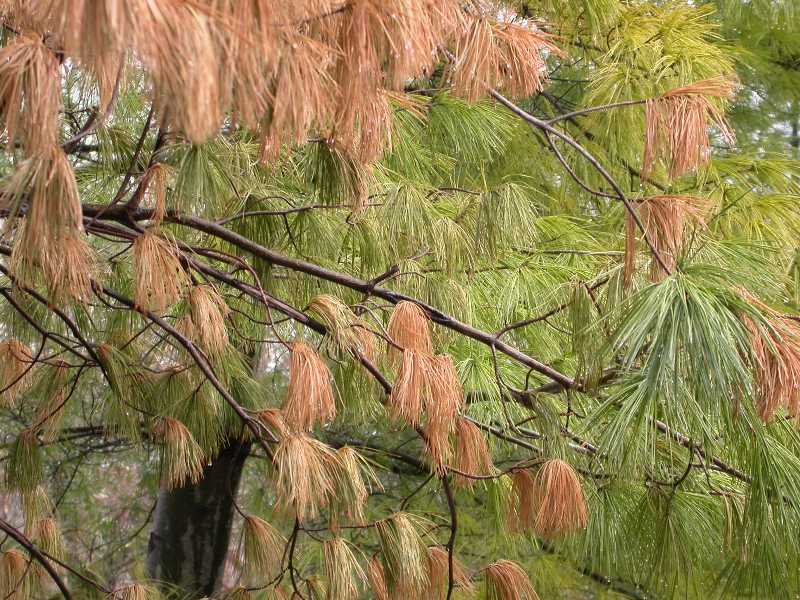
Across Alabama, a lot of people have been noticing pine trees turning brown, and one of the biggest culprits right now appears to be brown spot needle blight, a fungal disease that has been spreading through the state’s pine forests. The disease causes needles to develop brown spots, turn brown, and drop prematurely, often making trees look as though they have been scorched by fire. It was once mostly a problem for longleaf pines but is now affecting loblolly pines as well.
Other possible causes include:
- Southern pine beetles and other bark beetles, which attack stressed trees. Browning needles are often one of the first visible signs. Drought stress can make trees more vulnerable to beetle infestations.
- Pine decline, a complex problem involving drought, root damage, fungi, and insects. Trees may develop thinning crowns, short yellowish needles, and gradual dieback.
- Natural needle shedding, which can cause some interior or lower needles to brown without the tree actually being in danger.
Pine trees release phytoncides—aromatic compounds like α-pinene and limonene—that serve as part of their immune system. In a healthy forest, these compounds:
- Help trees resist fungi, insects, and stress
- Create that crisp “pine” scent
- Contribute to the calming, immune-supportive effects studied in Shinrin-yoku
1. Early stress → temporary increase
Trees often ramp up phytoncide release as a defense response.
- You might actually smell a stronger pine scent in some areas
- This is the tree “fighting back”
2. Advanced decline → sharp decrease
As needles die and the tree loses vitality:
- Photosynthesis drops
- Resin production slows
- Phytoncide output declines significantly
Eventually, a dying tree contributes very little.
What This Means for the Forest as a Whole
Even if some trees are browning:
- Mixed forest resilience: Healthy trees nearby continue producing phytoncides
- Microbursts of compounds: Stressed trees can still release bursts during defense
- Overall effect: If decline becomes widespread, the total atmospheric phytoncide level in that forest can drop
So the experience shifts from rich and saturated to more uneven and subtle.
What You Might Notice Personally
- Less of that deep, grounding pine aroma in heavily affected areas
- More noticeable scent near healthy stands or after rain (which releases oils)
- A different “feel” to the forest—less vibrant, sometimes drier or quieter
The Bigger Picture
Forests are adaptive systems. Even when pines struggle:
- Other plants (hardwoods, understory species) continue releasing beneficial compounds
- Over time, forests often rebalance and regenerate
So while pine-specific phytoncides may decrease in affected areas, the forest doesn’t lose its healing chemistry entirely—it just changes.
~Step into Stillness~

 alabamaforesthealingco
Leave a comment